
I’ve now seen Dune: Part Two, the sequel to Denis Villeneuve’s 2021 adaptation of the legendary scifi doorstopper novel by Frank Herbert, written in 1965. Such a weighty tome combined within it disparate strands of resource monopolies and their impact on transgalactic affairs, feudal power structures and indigenous rebellion, and shadowy manipulations of human destiny through breeding control and supernatural psychic control. It’s daunting, introspective, bleak and forbidding. Prime fodder for an emerging goth such as I, who waded through the first three books as an overawed juvenile.
But before even picking up the books, I was exposed to the 1984 film adaptation by treasured outsider, auteur director David Lynch, at an incredibly young and impressionable age. I loved it and still do. I went to see it on the big screen at my local community cinema not long after Villeneuve’s Dune came out and tweeted along – sharing my joy over an infamous box office bomb that has thankfully been redeemed as a cult classic.
Because it is a classic. In its sprawling, chaotic nature is the kind of twisted beauty that has made Lynch a byword for outsider movies of exceptional quality. I can do no better justice than John Devore’s review for the The Decider, which carries the finest headline of any article I have read.
I aom to do that headline justice, by holding Villeneuve’s attempts to the same jet black measuring bar. I found Part One met the conditions comfortably, introducing Paul Atredies as played by the pale, brooding and tortured adolescent Timothee Chalamet and thrusting him into the depressing and dangerous world of intergalactic politics. He is beset with danger and dread, and tackles all in a range of black flowing clothing. A+.
The first instalment concluded with Lady Jessica and Paul Atredies fleeing Harkonnen clutches for the native Fremen of Arrakis, seeking in their company salvation and revenge against a mutually hated foe. And just perhaps, prophecy fulfilled and destiny achieved – whatever those concepts mean in this cynical and manipulative future.
Dune: Part Two then (not Dune II, I must sadly clarify) continues the story and focuses now on Paul coming into his own, tackling not only his father’s political legacy as ducal heir, but the mystical prophecy of the Lisan Al-Gaib. The young Atredies would rather seek vengeance for his assassinated father and oblitered Great House, than step into the coldly developed Messiah role slyly introduced into Fremen legend by the supreme plotters of the Bene Gesserit. Indeed, this is a key example of the story’s themes of unavoidable destiny entwined with supreme, unchecked power.
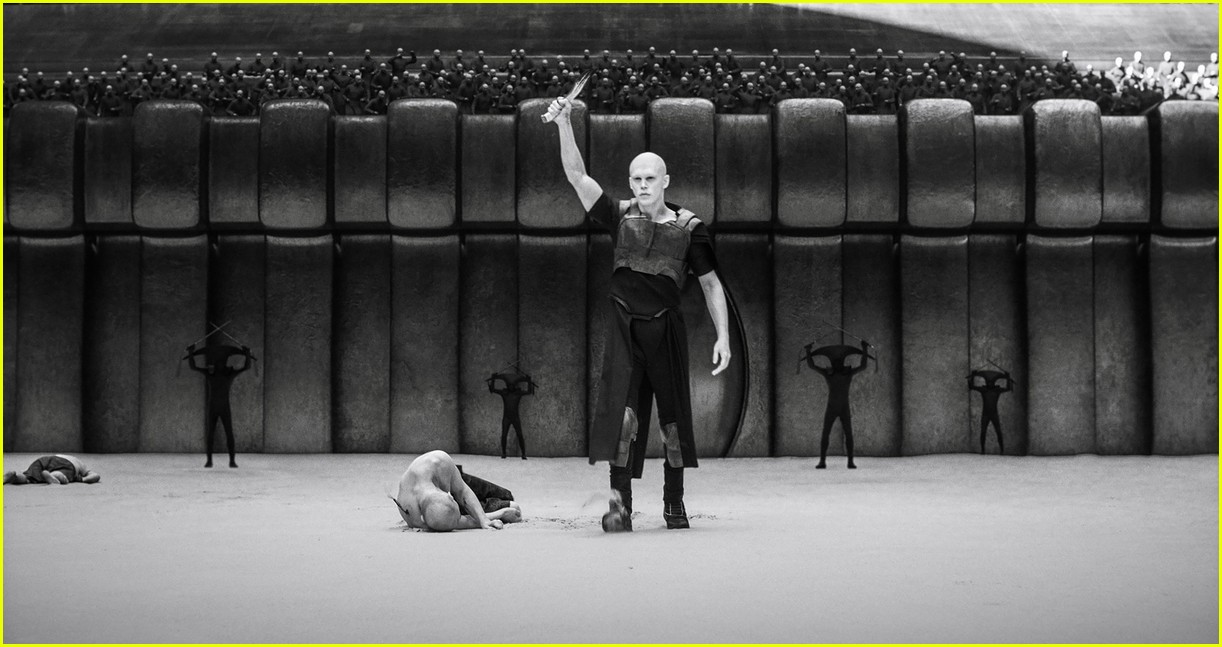
The storyline is well known to fans by now, and myriad critics have already gone over the film in professional terms. I am keen now to establish if Part Two maintains the specific tradition of being ‘Star Wars for Goths’! Returning briefly to those reviews, I appreciate the BBC noting the very first attempt to adapt Dune, by Alejandro Jodorowsky, included famed Swiss artist H.R. Giger. Giger would find later fame on other projects, notably Ridley Scott’s ‘Alien’, and his body-horror sex-inflected biomechanical monstrosities would become a mainstay of many goths’ artistic palettes!
It became a running theme in Dune, and is realised in Villeneueve’s version so magnificently and morbidly on Giedi Prime, homeworld of the villainous House Harkonnen. Forget the extraterrestrial house-party of Jabba’s Palace in Return of the Jedi, instead pay a visit to the S&M basement of the Grand Arena where psychotic nemesis Feyd Rautha casually slaughters at whim amongst his pale, bald retinue – more than shades of Clive Barker’s Hellraiser series, amongst other horror parallels. All of it shot in glorious monochrome, the medium of choice for emerging goth bands making their impactful first music videos.

Contrast the high style sadism of the Harkonnens with the dusty utilitarianism of the Fremen, also clad in black but more authentically faded for that old-school cred. Whilst they dress like veteran rivetheads, the Fremen social and cultural system speaks more to reluctant dancefloor comrades amongst the New Model Army crowd, and I doubt – grey leather all splattered with the dusty sand of Arrakis – they’d stand out much amongst the hardcore front row of a Fields of the Nephilim concert.
Beyond the confines of the desert world, Dune is also a story about contesting the arch-villain of the series so far, the Padishah Emperor of the Known Universe, portrayed beautifully by the cadaverous Christopher Walken. What’s this – a geriatric string-puller obsessed with power employing devious tactics to secure the grip of their dead hand on a scene, sorry I mean galaxy? I’m going to be diplomatic and let you make any comparisons you want to lead singers of golden-age goth bands…
The film soundtrack is a stone-cold classic of course – I’d expect nothing less from the acclaimed Hans Zimmer. Whether it be the daunting wastes of Dune, the frenetic danger of the Harkonnen arena or the fraught love between Paul and Chani, the sounds are always vast, overawing, brooding and intense. Not for the first time do I draw a comparison with the ambitious soundscapes of Dead Can Dance, who could fit seamlessly into the sonic dimension of Frank Herbert’s universe.
Ultimately, I came away having thoroughly enjoyed Part Two – but finding unavoidably there was far more action and progress for the characters, than the delightful introspection and exposition of Part One. Understandably as that is how Herbert’s original story builds to its final denouement, but it feels more like a grand-scope conventional scifi story than the cerebral and subtle energy of its predecessor. I also came away lamenting some of the changes Villeneueve had made and found myself, for example, boggling over the cameo of Alia Atredies who is otherwise absent from this contracted timeline for Part Two.
But these are broader issues that stray from the main focus of my article. Suffice to say that if you’re interested in a group of beautiful people, ornately dressed in other-worldly style, talking about stifling dissent, controlling people’s intrepretations and their access to a certain lifestyle, all set to daunting and foreboding music, you’re probably a goth. Who will enjoy Dune: Part Two.


 The Blogging Goth