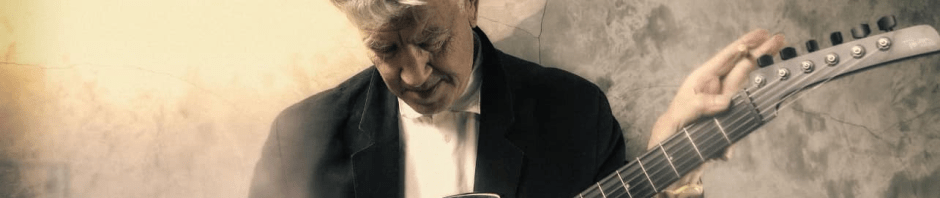
I’m not a fan of horror movies. It’s a terrible thing for a proudly self-professed goth* to admit, that they don’t enjoy a widely celebrated aspect of their subculture. But I come to resent the carefully constructed method of provocation and suspense, or slew of shock and gore that is cunningly targeted to prod an audience in a pre-set direction of reaction. Jump-scares just piss me off.

So it shouldn’t be too surprising that I consider the work of award-winning auteur David Lynch so engrossing. To classify him as merely a horror director would be criminally restrictive, and yet there is a rich vein of unearthly and disturbing style that runs through his oeuvre.
Perhaps it’s because it landed so relatively early with me – I was less than ten years old when I saw his controversial 1984 space-opera, Dune. An adaption of the sprawling epic tale by Frank Herbert of politics, religion, ecology and pharmaceuticals that bend time and space as well as the mind, it should have been Lynch’s magnum opus. Instead it was legendarily fraught, critically slated and then disowned by the director himself after a vicious bloodletting with the editors at the studio. Well, it could have been worse. It could have been Return of the Jedi that “won” a Stinkers Award for Worst Picture!
None of this meant anything to me at the time. I was overawed by the grand spectacle, entranced by the ephemeral storyline and hypnotised by the beautiful and repellant cast as they negotiated situations and scenarios so complex they went totally over my head. In that, the germ of an idea, the attraction of a David Lynch project took root.
It would be many years before it blossomed though, with another shameful admission – I didn’t see Twin Peaks until the 2010s and only on the recommendation of the laudable Professor C! I am quite bad at consuming modern media, buried as I am right now in 80s vinyl or rewatches of 90s TV shows. But I distinctly recall watching the first three episodes of Season One, back to back on a cross-country journey. In that most liminal of spaces, the conceptual no-place of a speeding train, I was lost entirely in the most infamous of Lynch’s parallel universes, concluding with my first visit to the Red Room.
I had no idea what was going on, I was unnerved and I was in love. From there on out, my favourite moments became those surreal showstopper sequences of his various projects. The lip-synched performance of Roy Orbison’s In Dreams from Blue Velvet, Phillip Jeffries inexplicable appearance and incomprehensible tale in Fire Walk With Me, or the confrontation with The Cowboy in Mulholland Drive to name a few.
What is happening in these scenes is up for interpretation and I would argue are at the heart of the style we know celebrate as Lynchian. It is commonly held that a Lynchian theme is one that melds the commonplace with the uncanny, the serene and the surreal – but for me the crowning achievement is the utterly incomprehensible, dread-inducing intrusion into ‘our’ world from some utterly inhuman elsewhere. It may not even be intentionally malign as we recognise it, but it is so alien as to be actually hostile by its very existence.
It instills in me a delicious sense of dread, a thrill of something approximating terror but without any of the transparent, aggravating tricks of a ‘conventional’ horror film. Lynchian horror introduces something like existential fear, a deep-seated aversion from the very back of the psyche, and in the same realm as the uncanny valley concept. To me, spectres and slashers are pale comparisons at best to the soul-wrenching nightmare that was Episode Eight of Season Three of Twin Peaks, aka The Return. The critical consensus is it’s one of, if not the finest work by Lynch ever.
It is Lynch’s film career that we focus on, of course. But he was creative across multiple mediums, for example working closely with composer Angelo Badalementi on the soundtrack to Twin Peaks and with co-star Chrystabell on her dreamy-eerie pop, alongside his own sonic endeavours. He was a student of painting, and then a creator in many other artistic genres. He made his own furniture and designed an entire club in Paris!
David Lynch was a conduit of creativity, channelling extraordinary vision into our universe that defied easy description or sometimes even any comprehension whatsoever. He embraced Transcendental Meditation, bumbled helplessly through contemporary politics, and during lockdown broadcast the weather in LA out to the world with that trademark foghorn volume and nasal twang, vibrating with sincerity from one of the unrealest places on the planet. There was nobody quite like Lynch and never will be, but I hope others will pick up the baton and continue the Lynchian genre, exploring the other planes of reality he first reached.
Wherever he is now, I hope it’s blue skies and golden sunshine all along the way!
* – self-professing as a goth is also a serious faux pas.
The Blogging Goth is proudly supported by its Patrons – I couldn’t do this without your generous support. To find out more about keeping The Blogging Goth ad-free, and what unique benefits you get as a Patron, please visit my page! I’ll add some extra content there for you Patreons…
Vaughan Allen
Martin Belam
Claire Victoria
Mark Chisman


 The Blogging Goth
i sometimes forget…
in the olden times, hype and knowledge of an artists works did still exist, but it was more organic and word of mouth. And we couldn’t just use IMDB to find more, then stream them all
and of course we were young and poor, so whilst I may have seen Dune before Twin Peaks, it’s the latter – taped and watched week by week – that was my first introduction to his world.
as for it being horror, yes in a weird space slap bang between the eldritch horrors and the mundane.
LikeLike