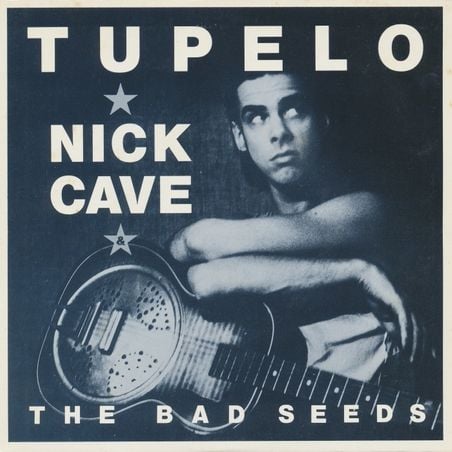
On this day forty years ago, Nick Cave and the Bad Seeds released their second single ever, the harsh and relentless “Tupelo” from the second album, “The Firstborn is Dead”.
It’s classic early Bad Seeds, awash with biblical Armageddon and Americana by way of epic reimagining. It’s remained a mainstay of their live sets over four decades and in his missives to fans via the Red Hand Files, it’s clear Cave personally holds it in high regard. So how are we to interpret the AI-generated music video he has shared with fans on this anniversary?
It seems fitting that Cave would share this content with us via the Red Hand Files, the medium by which fan and performer can interact directly without intermediate steps. It is AI that notionally brings creator and content closer together, removing the intermediate steps of having to create anything beyond a prompt.
Cave is initially sceptical of the video, created by Australian director Andrew Dominik who has collaborated with Cave on several music videos and the heartfelt “Once More With Feeling” documentary. “Jesus,” says Andrew to Cave. “Suspend your fucking prejudices and take a look!” So, let’s do as the man says.
“As I watched Andrew’s surreal little film, I felt my view of AI as an artistic device soften.” Cave admits, and I can see why. It’s a smooth, slick, eerie accompaniment to Cave’s legendary lyrics, and what artist wouldn’t be dazzled by such enabling of his subconscious vision? A powerful mechanism for achieving artistic goals, a subversive technology that will break paradigms and is front and centre of a worldwide debate, it is an enticing topic to engage with.
The other thread through Cave’s response in the Files is entwined, where he exhorts us to “[remain] flexible and humble enough to adjust our views as new evidence emerges, regardless of how uncomfortable that may feel”, such as adjusting to a world where AI creativity is widespread, perhaps? He concludes by inviting responses to the video from us the reader – the core concept of the Files and how Cave likes to interact with people directly. Again, a shortening and smoothing of the way, between artist and audience in much the same way AI can shorten the way between artist and vision. I can see the appeal, again.
I don’t share it though. I consider AI insidious, amoral, unethical and a hollowing out of art as the product of skill and effort, not just imagination. I found the video horribly unnerving, speaking to that deep-seated Uncanny Valley fear, as static images began to bulge and distort in a horrible simulacrum of real human movement. Sequences showing the town beset by apocalyptic weather ring utterly false, badly realised and strangely subpar to regular special effects. The marionetteing of Elvis Presley is mawkish, potentially offensive and occasionally laughable. If this had come up in an A-Level media student’s coursework, I wouldn’t have blinked twice before tossing it aside.
This is before we come to the real objections of using artificial intelligence, particularly Generative AI. The environmental impact is still being assessed, but even the most allowing studies all agree that AI will grow exponentially, placing more and more demand on finite resources – particularly those most affected by a declining environment, such as fresh water and energy resources.
From an artistic standpoint, Generative AI is an existential threat of immense proportions. With an iterative learning process that fuels GAI, at what point does it stop being a “tool” to achieve your vision, and start eclipsing you? The video to “Tupelo” has clearly been produced in Andrew Dominik’s style – so what’s to stop me cutting him out of the process, and asking for a video made in his style?
Hell, why don’t I go a step further and feed into AI all the written lyrics and video recorded performances of Nick Cave and ask it to generate me an entire new album? What need have we of artists if we can all download the ideal version of music, film and art?
Lest I be branded a hypocrite, I should acknowledge AI was used in a music video for my band, The Scarlet Hour. We carefully limited it to additional special effects flair in a few sequences, and agonised over even that minor involvement. So I do not consider myself a fervent anti-AI reactionary or luddite – but I am under no illusions as to how swiftly GAI and other technologies will be adopted in a post-capitalist, resource-scarce society. We must adapt like we did to the combustion engine and the internet, with difficult transitions in workplaces and careers that will inevitably be negatively impacted.
The cold reality is that artificial intelligence will absolutely take root in every aspect of society it can colonise. But the lie we were all sold was that it should take some of the burden of labour from us so we can pursue recreation and creativity. Sure, some will argue that creativity is itself a laborious burden – but doesn’t that make us appreciate the end product all the more? Not to mention those who relish the art of creation as much as the art itself.
So it is with surprise and sorrow over creators who’d so brazenly use the tools that could replace them in a generation. I predict there will still be an appetite for non-AI enabled content, but like connoisseurs of vinyl it’ll be a niche hobby or interest to actively seek out content creators who work without LLM assistance. Otherwise, AI will get better and better until it becomes an undetectable element of all the content we consume – with an undetectable human involvement, unpredictable environmental fallout, and immeasurable loss to ourselves.
The Blogging Goth is proudly supported by its Patrons, honoured below – I couldn’t do this without your generous support. To find out more about keeping The Blogging Goth ad-free, and what unique benefits you get as a Patron, please visit my page!


Martin Belam

Mark Chisman
Eugene Carey


 The Blogging Goth