
Australian Prime Minister Anthony Albanese got an early Halloween shock when he was thrust into a cultural quandary at the end of October, after being photographed wearing the iconic “Unknown Pleasures” shirt by Joy Division. Normally a ubiquitous piece of post-punk apparel, his opponents chose to seize on the grim origins of the legendary band’s name to attack him. I’m digging further into this unique scenario where proto-goth and politics collide, but caution readers the content that follows can be distressing and offensive.
Hon. Sussan Ley MP, Leader of the Liberal Party and Opposition Leader to Albanese, attacked the Prime Minister for sporting a t-shirt that allegedly “parade[s] an image derived from hatred and suffering”. This is because Joy Division, formally Warsaw, took their new name from a 1953 novella that describes concentration camp brothels under the Nazi regime as ‘joy divisions’ – there’s more detail on the name later in my interview with Daniel Rachel.
Her political move followed an Op-Ed piece on Sky News Australia by conservative host Sharri Markson, also lambasting the choice of clothing as a “bad case of moral confusion” and recounting the inspiration behind the band’s name – along with some confrontational commentary tied up in wider issues around Middle Eastern politics and antisemitism. This can be seen below, with the advisory that this can be disturbing viewing.
At the heart of the issue is why a band formed half a century ago, and long-since hailed as one of the most imaginative and revered outfits of the 20th century, has suddenly emerged as a thorny topic in contemporary politics. Cynically enough, it’s a viable line of attack in the always vicious arena of politics – and never before has society been in the grip of a political permacrisis. It also taps into the growing crisis around culture wars and the specific growth of antisemitism, all of which contribute to and spring from political debate.
For those as yet unfamiliar, I reached out to an expert to explain the link between the Manchester post-punk legends and the worst crimes of the Second World War.
Hi Daniel, thanks for talking to us. Could you introduce yourself, and your book?
I’m a former musician now author of music / cultural history books. This Ain’t Rock ‘n’ Roll: Pop Music, the Swastika and the Third Reich is my sixth book. It is an account of pop music’s complicated history with fascism and the imagery surrounding it. It has been a tremendously difficult book to write. But I believe necessary.
As a teenage music fan, I struggled to reconcile rock ’n’ roll’s rebellious attitude with my understanding of the horrors committed by the Third Reich. The swastika links both as an emblem of Nazi oppression but also a leitmotif for rock ’n’ roll defiance. Today, the global rise of fascism challenges the defeat of Nazi Germany and the Axis powers in the Second World War. If rock ’n’ roll is to remain at the vanguard of the revolutionary spirit it needs to confront its shortcomings, stand against persecution, and address its historical failings.

I wonder if you could outline the inspiration for the name, for readers discovering this for the first time. Some outlets are noting professional organisations are indicating there’s no evidence that supports the existence of actual ‘Joy Divisions’ – could you speak to that?
The term ‘Joy Division’ originates from the 1953 novella House of Dolls, in which the author, Ka-tzetnik 135633 (his former prison name and number) coined the phrase Freuden-Abteilung. This German expression, a translation of the original Hebrew, combines the words Freuden (joy) and Abteilung (division).
Camp brothels, or Lagerbordelle, were created under a directive from Reichsführer-SS Heinrich Himmler to Oswald Pohl, the SS administrator of concentration camps, to function as an incentive for ‘healthy’ prisoners to increase productivity in armaments and to combat homosexual activity that was common in camps. ‘I consider it necessary to provide in the most liberal way hard-working prisoners with women in brothels,’ Himmler stated.
Between 300 and 400 women, registered by the SS ‘volunteered’ for forced sexual labour in ten concentration camps – including Mauthausen, Sachsenhausen, Ravensbrück, Buchenwald, Dachau and Auschwitz – housed in what were known as ‘special huts’ or ‘dolls’ houses’. Valued prisoners – cooks, hairdressers, firefighters, those working for the SS – were issued vouchers to ‘cash in’ at the brothel. Jewish and Soviet prisoners were forbidden from using the brothel to uphold Nazi ‘blood purity’ laws.
But make no mistake: this was legalised rape. The brothels were places of brutality and humiliation. Women volunteering for ‘very light labour’, in the hope of earning a piece of bread or a promise to be released after six months, soon discovered the deception. Women were examined – for venereal diseases – and sterilised, not only to prevent pregnancy in the short term, but consequently, if a prisoner survived the ordeal, to terminate their potential as birth mothers.
Nazi “anti-miscegenation” laws meant sexual relations between German and Jewish individuals were forbidden, so some question if there were actually Jewish inhabitants of camp brothels. This is not to diminish in any way the horrors of these institutions, but factually question the narrative in the media.
No. Despite the racial laws, rape was used as a weapon of war. Documented proof from survivor testimonies and witnesses show all women were subject to male violence. This included Jewish people across Europe. Racial laws did not prevent soldiers, often German, raping Jewish women, nor subjecting them to unspeakable horrors. That included sexual slavery.
Why do you think some bands like Joy Division used such provocative imagery from the most reviled regime in history?
Many musicians and bands, like Joy Division, were knowledgeable about the Second World War and the rise of the Third Reich. The provocative use of imagery was in many cases to simply look cool. To flirt with imagery without acknowledgement of the atrocities committed by the regime i.e. separating theatrical spectacle from a murderous regime.
I wonder also what you’d say about Albanese himself not being aware of the origins of the name, as brought up in a podcast interview he participated in (as quoted by Sky News Australia). Is there a responsibility there to be aware, to anticipate political hay being made of your music choices?
Whether Prime Minister Albanese was aware or not of the origins is obviously an important question to ask. But since world media attention has made clear the source of the name, Albanese has a responsibility to acknowledge cultural flirtation with the terminology of the Third Reich and the suffering of those at the hands of the Nazi regime.
I’d be very interested to hear what advice you would give to Albanese or other political leaders who might have professed an interest in bands like Joy Division, Siouxsie and the Banshees or Motorhead who have similar associations with provocative and offensive imagery. Is this a warning to stray into safer, less offensive interests like Coldplay, or evidence of mountains being made from molehills in an increasingly acerbic and toxic political and public sphere?
Yes, I will keep playing ‘Love Will Tear Us Apart’. No, I will not play Coldplay! In my effort to avoid casting myself as the Simon Wiesenthal of rock ’n’ roll , This Ain’t Rock ‘n’ Roll tries to strike a delicate balance between explanation and not attributing blame – a challenging task – but simply to say: Here is what happened; here is the evidence. There was no attempt to compile a list of artists to denounce; this story is much broader than my own likes or dislikes.
I am not advocating for the censorship of their music. But I do believe that using history creatively carries consequences. Holocaust-related language or Nazi symbols in popular music should be aligned with their historical context. My hope is that the book provokes critical discussion and challenges us to consider whether pop music’s embrace of Third Reich imagery is a fitting way to honour the memory of the six million Jews and the lesser-known victims of the Nazi Aryan vision.
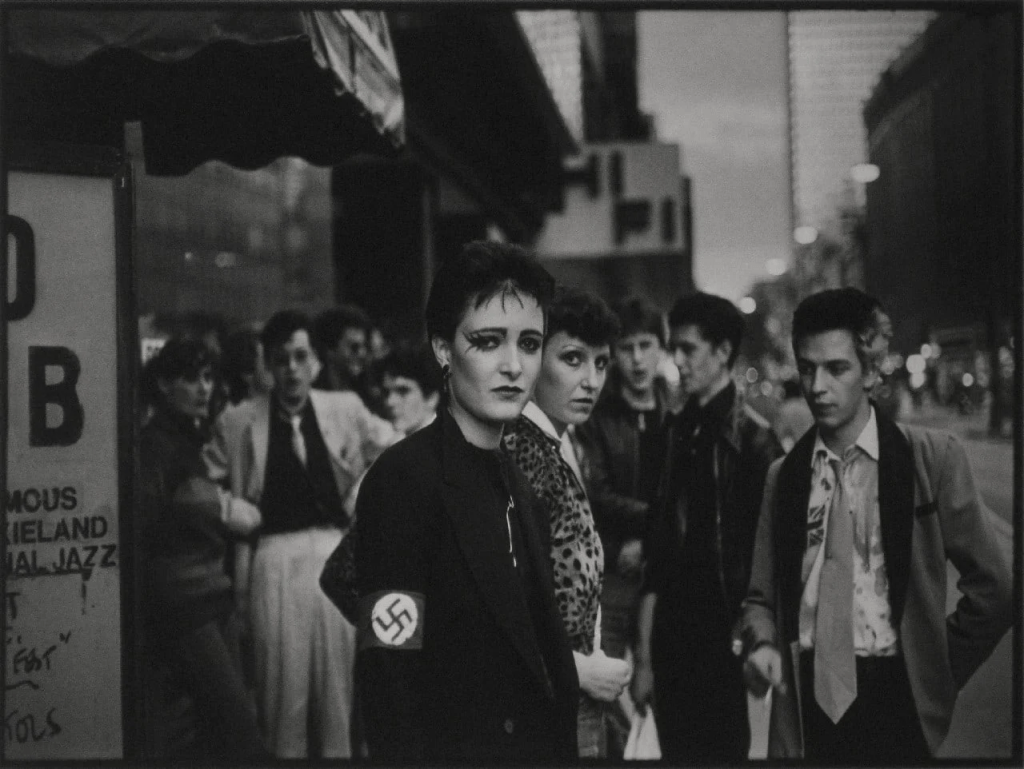
I’m grateful to Daniel for his informed and detailed responses to my questions. Siouxsie’s early flirtation with Third Reich imagery also surfaces occasionally online, as fans rediscover this provocative look. I read Professor Claire Nally’s article “The style terrorism of Siouxsie Sioux”, in the academic text Let’s Spend the Night Together: Sex, Pop Music and British Youth Culture, 1950s–80s, that seeks to explore how the Banshees singer used the swastika as part of a broad wardrobe that sought to violate any number of taboos and provoke post-war Britain culturally.
At one point Nally quotes – from the Banshees biography by Mark Paytress – a ‘Bromley Contingent’ contemporary of Siouxsie, who commented of her usage of Nazi symbology “It certainly wasn’t pro-fascist, pro-Nazi. It was more “What’s the worst thing you can do to your parents who’d fought and died in the War? Really fuck them off.” This feels like the closest to a realistic explanation for this behaviour that I’ve heard. An angry gesture of rebellion and defiance against an overbearing Greatest Generation, just as easily discarded as it was picked up.
It never stopped provoking however, and in these straitened times of extreme division, the reactionary identity politics of punk and post-punk will shock even more – and in the hands of your ideological opponents, a simple t-shirt becomes a potent weapon of the culture war. It remains to be seen if Albanese can remain a ‘Leader of Men’ in the grip of this crisis. Read into Curtis’ lyrics and you can gain some of his perspective on authoritarian regimes…
“Thousand words are spoken loud
Reach the dumb to fool the crowd“
The Blogging Goth remains happily ad-free and online, all thanks to the generous contributions of my Patrons. As well as recognition for their ongoing support, they enjoy regular updates, advance notice of upcoming content, and the opportunity to contribute as valued members of my Patron. Please consider joining from as little as £1 a month!


Martin Belam

Mark Chisman
Eugene Carey


 The Blogging Goth