
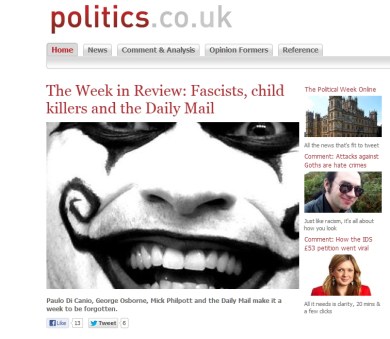
Whoever designed the Politics.co.uk website today has a wry sense of humour…
The media – both within the UK and abroad – has given a lot of coverage to the decision by Greater Manchester Police to record relevant crimes against members of alternative subcultures as Hate Crimes.
We were flattered to be contacted out of the blue by Politics.co.uk, to provide a perspective from within the scene. You can read the article by Tim Sinister on their website over here – we hope you find it balanced, and that it addresses all of the significant issues. Certainly we hope we’ve communicated the basic idea – that the only reason this is even being considered is a hate crime is because of the extensive and mounting evidence that victimisation of those within the alternative subculture is, well, extensive and mounting – especially compared to other groups that critics roll out in hypothetical comparisons, such as the obese, or gingers!
As it is, the debate will continue and as always – more research is required.
In covering the event, the BBC have been generous – it was a hot topic on the popular BBC Radio Two show presented by Jeremy Vine, who raised it as his first talking point, and who had Assistant Chief Constable Garry Shewan as his guest – who held his own well against the provocative and bullish Vine!
The BBC has also provided extensive coverage via the definitive Today programme, their relevant regional website, Radio One’s Newsbeat, and their main news pages with a video sequence, plus interviews on the breakfast bulletin. They even provided a rough kind of guide to the various alt tribes, as produced by slightly bemused outsiders, but crucially interviewed some very knowledgeable sources on the matter – including Paul Hodkinson and Jon Garland, who are known to readers of this blog! Finally, the BBC excelled themselves by interviewing someone who has suffered assault as a result of their appearence. Then, The Independent went better by speaking to lots of people who have been attacked, including Louise Street who has also contributed to The Blogging Goth!
It’s worth noting the responses from critics within the media as well – vital reading comes from the always divisive Richard Littlejohn, formerly of The Sun and now of the Daily Mail. It’s always wise to remember that Littlejohn must maintain his reputation as a caricature of himself!
The idea of it being a political move, in slightly more coherent terms, is also expressed by Charles Murrary of The Guardian, although they provide balance with an opinion piece by Simon Price – even if he does make the heinous journalistic mistake of citing Marilyn Manson!
Also falling into that trap is Channel Four, who nonetheless end it well by saying that all we ask is for the freedom to be different. This in part I believe undermines one of the problems opponents have with this proposal – that it’s just ‘kids knocking kids about’, atypical yoof-culture scraps.
In reality, it’s a quieter, non-confrontational and passive group that is being hounded without provocation, to violent extremes. It’s unusual, remarkable, and as such Greater Manchester Police are responding with appropriate attention.
Solidarity was shown from Pink News, who bill themselves as Europe’s largest gay news service and who quoted a major anti-hate crime charity as saying the proposals have their full support. The Stop Hate UK article on the news is excellently researched and should be mandatory reading for anyone interested in the working mechanics of this decision.
The Telegraph ran a couple of articles reporting the news in, well, strict news speak – but their Opinion writer, Colin Freeman, was not so sure about the importance of this decision. Nelson Jones of the New Statesmen put eloquently what other critics have, that it’s ‘watering down’ the very concept of hate crimes, defining some crimes as worse than others.
This illuminates one issue I hope I’ve covered, that in reality we should regard all hate-motivated crime equally – and also specifically different to crime motivated by greed or politics or the other prime motivators of law-breaking. Should harassment for the way you dress or the music you listen to be less important than being assaulted for choosing to be gay or embrace Islam? Hate crime should cover all abuse for any form of deviation – as long, of course, as it remains legally permissable!
This isn’t by far an exhaustive list of the widespread reporting on the matter – but you can always read more, and see if your local news organisation have an opinion. It could be they’re looking for someone to talk to about this decision – so get out there and make contact!


